[IBK ChangGong Gwangju Startup CEO] leecell, Developing Next-Generation Solar Cell Films
CEO Lee Kwang-hee
Developing ultra-lightweight and flexible solar cell films that overcome the limitations of conventional solar cells
Capable of generating power even in low-light environments such as cloudy conditions or indoors
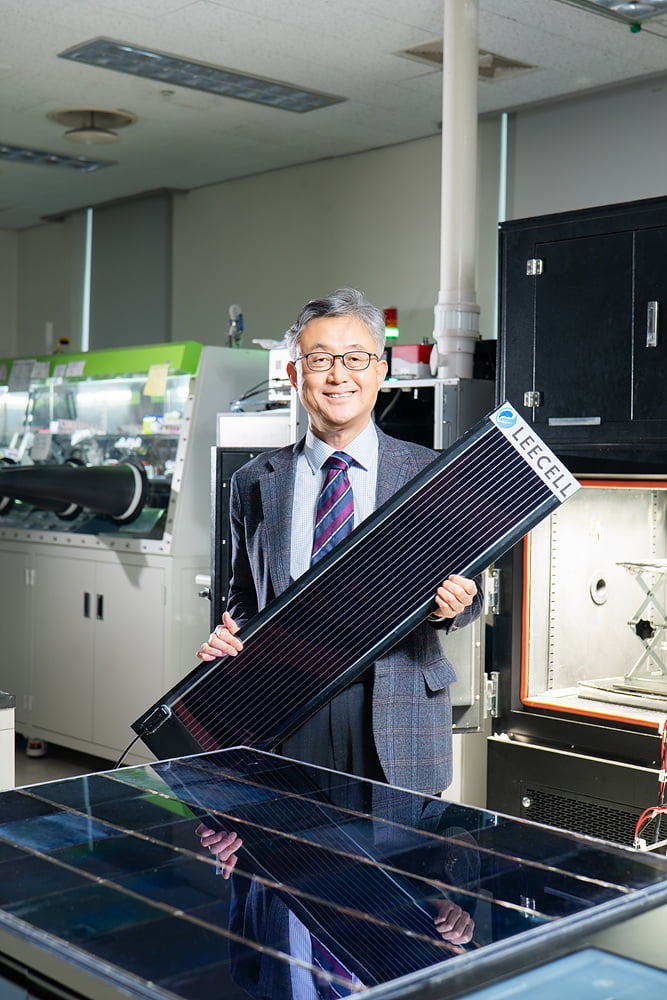
is a faculty startup from Gwangju Institute of Science and Technology, developing ultra-lightweight and flexible solar cell films that address the limitations of conventional silicon solar cells, with the vision of creating a world where energy can be freely used anywhere. The company was founded in November 2022 by CEO Lee Kwang-hee.
Its flagship product is a next-generation solar cell film. Conventional silicon solar cells, which dominate the current solar market, are heavy, rigid, and fragile, making them unsuitable for curved surfaces. In contrast, leecell’s film-type solar cells are lightweight—approximately one-tenth the weight of silicon—and highly flexible, enabling installation on various curved surfaces such as building facades, vehicle sunroofs, and greenhouses. In addition, they perform efficiently even under low-light conditions, making them applicable across a wide range of fields, from indoor IoT sensor power sources to building-integrated photovoltaics (BIPV) and mobility-integrated photovoltaics (MIPV).
leecell’s core competitiveness lies in its superior cost efficiency and application flexibility. When mass-produced, the next-generation solar cell film is expected to cost approximately one-third of conventional silicon cells. Its lightweight nature significantly reduces installation and construction costs. The film form allows attachment to virtually any curved surface, including weight-restricted environments such as rooftops, building exteriors, vehicles, and drones. Moreover, it can generate power even in low-light environments such as cloudy weather or indoors. The company has established strong barriers to entry by securing proprietary wet-process technology for next-generation solar cells and numerous domestic and international patents.
leecell focuses on providing demand-driven B2B and B2G energy solutions. In B2B, it collaborates with companies in the window, mobility, home appliance, and IoT sectors through joint development and proof-of-concept (PoC) projects, delivering customized solutions and converting them into mass production contracts. The company also positions its products as solutions for ESG and RE100 initiatives. In B2G, leecell provides solutions for zero-energy buildings (ZEB) for governments and public institutions, while expanding into the public sector through procurement and demonstration projects. The company is actively developing four key business areas: low-light photovoltaics (LPV), building-integrated photovoltaics (BIPV), mobility-integrated photovoltaics (MIPV), and agricultural photovoltaics (APV).
Recognized for its technology and growth potential, leecell has successfully secured both government R&D funding and private investment. In 2023, it was selected for the Deep Tech TIPS program by the Ministry of SMEs and Startups, receiving KRW 1.5 billion in R&D funding. As of 2025, the company has secured approximately KRW 4 billion in combined research funding and investment. It is also planning to raise bridge investment to accelerate commercialization through mass production.
Regarding the motivation for founding the company, CEO Lee stated:
“In the era of energy transition, achieving true carbon neutrality requires alternatives that go beyond the limitations of conventional silicon solar cells. After more than 30 years of research, next-generation solar cell technology has finally reached a level close to commercialization. Through this, we aim to address global energy shortages and imbalances. We were confident that our ultra-lightweight, flexible film-type solar cell technology could enable energy generation anywhere—from buildings and mobility to everyday devices—which led us to establish leecell as a GIST faculty startup. Initial funding was secured through GIST startup support, along with the Deep Tech TIPS program and seed investment in 2023.”
Reflecting on the journey after founding the company, Lee added:
“The most rewarding experience has been transforming a technology developed in the lab over 34 years into a tangible product—the next-generation solar cell film—together with our R&D team. It was truly fulfilling to see this long-envisioned technology finally realized.”
leecell possesses a total of 52 years of combined expertise in solar cell R&D, led by CEO Lee and CTO Kang Hong-gyu. The company currently has 16 employees, including 9 R&D personnel. Core R&D is led by former GIST researchers (2 PhDs and 6 master’s degree holders), while manufacturing operations are overseen by a veteran with 30 years of factory management experience. The organization consists of a Corporate Research Institute, Management Support Division, Brand Strategy Division, Technology Innovation Division, and Manufacturing Operations Division.
Regarding future plans, Lee stated:
“In the short term, our goal is to successfully launch the world’s first next-generation solar cell film product by 2026 and enter the initial market.”
“In the mid-term, we plan to establish large-scale mass production by 2028 and pursue an IPO through expansion in the domestic market. In the long term, we aim to secure overseas production bases by 2030 and enter high-value markets by 2032, becoming a key global supplier. Ultimately, we aspire to grow into Gwangju’s first unicorn company.”
Founded: November 2022
Core Business: Manufacturing of next-generation hybrid (organic-inorganic) solar cell films
Achievements: Selected for IBK ChangGong Gwangju; selected for the 2023 Deep Tech TIPS program by the Ministry of SMEs and Startups
Reporter 이진호 / jinho2323@hankyung.com
Source https://magazine.hankyung.com/job-joy/article/202512142844d